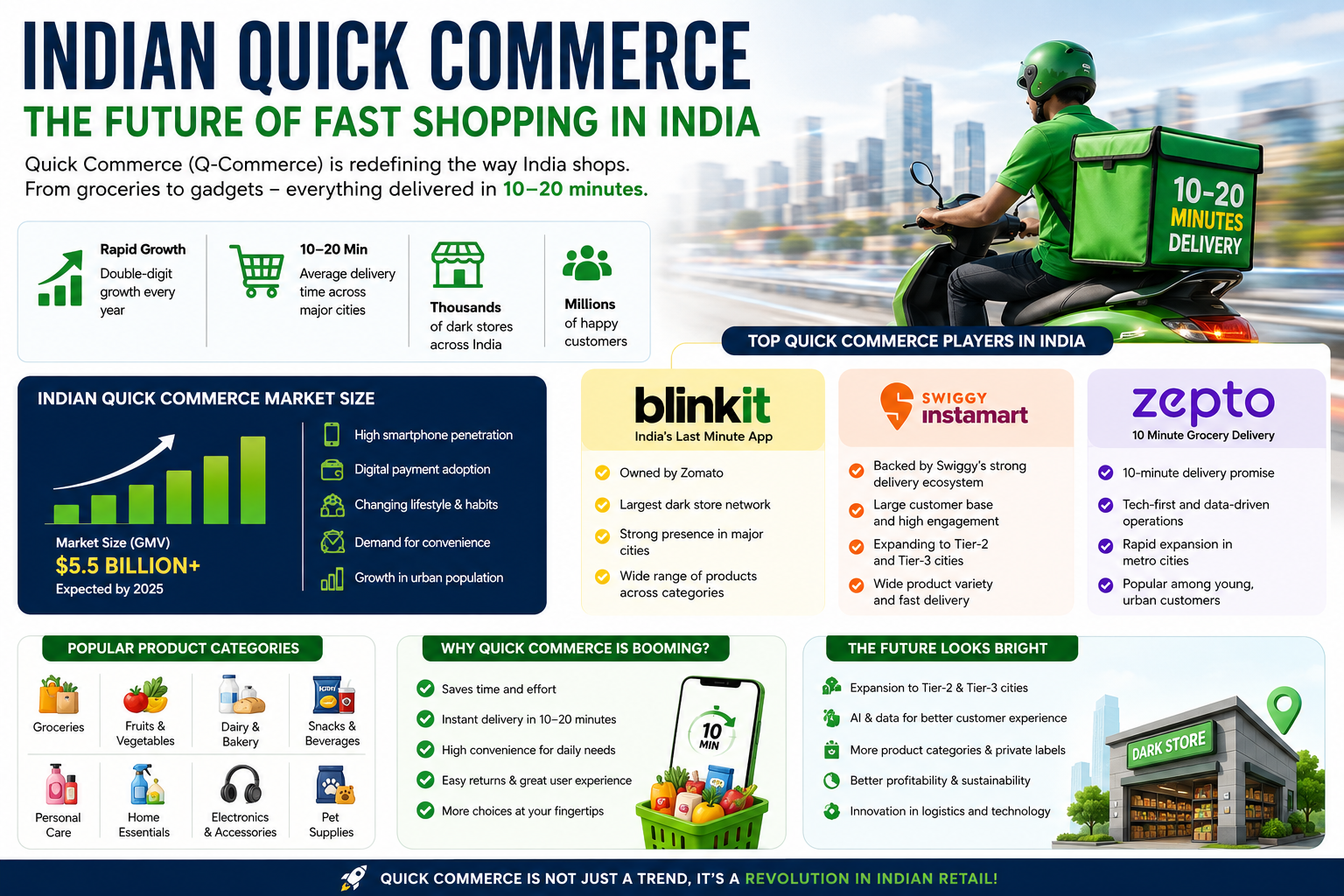
Quick Commerce
India’s retail ecosystem is witnessing a historic transformation with the explosive growth of Quick Commerce (Q-Commerce). What started as a convenience-driven delivery model during the pandemic has rapidly evolved into one of the most competitive and high-growth sectors in the Indian digital economy. Companies like Swiggy, Zepto, and Blinkit are aggressively expanding their dark store networks, reducing delivery times, and reshaping consumer buying behavior across metropolitan and tier-2 cities.
The Indian quick commerce industry is no longer limited to groceries. Today, consumers are ordering electronics, cosmetics, medicines, fashion accessories, pet supplies, kitchen essentials, and even premium lifestyle products within 10 to 20 minutes. This rapid shift has created massive opportunities for brands, sellers, logistics providers, and digital marketers across India.
What is Quick Commerce in India?
Quick Commerce, commonly called Q-Commerce, is an ultra-fast delivery model designed to deliver products within minutes instead of days. Unlike traditional e-commerce platforms that rely on centralized warehouses, Q-commerce companies operate through dark stores or micro-fulfillment centers strategically located near residential areas.
These dark stores help companies process and dispatch orders instantly, enabling deliveries within 10–30 minutes.
The major pillars of Indian quick commerce include:
- Hyperlocal delivery infrastructure
- AI-powered inventory management
- Demand forecasting
- Real-time logistics tracking
- Instant payment systems
- High-density dark store operations
India has become one of the fastest-growing quick commerce markets globally because of increasing smartphone penetration, digital payment adoption, and changing urban lifestyles.
Indian Quick Commerce Market Size and Growth Data
The Indian quick commerce market has experienced exceptional growth over the last three years. According to industry estimates, the sector is expected to cross billions in Gross Merchandise Value (GMV) over the next few years as consumer demand accelerates.
Key Quick Commerce Statistics in India
| Metric | Data |
|---|---|
| Average Delivery Time | 10–20 Minutes |
| Major Players | Blinkit, Zepto, Swiggy Instamart |
| Top Cities | Delhi NCR, Mumbai, Bengaluru, Hyderabad, Pune |
| Popular Categories | Grocery, Dairy, Snacks, Electronics, Beauty |
| Estimated Growth Rate | Rapid Double-Digit Expansion |
| Dark Store Expansion | Thousands of Stores Across India |
The increasing demand for convenience-based shopping has made quick commerce one of the most attractive investment sectors in India’s startup ecosystem.
Blinkit: India’s Largest Quick Commerce Brand

Blinkit has emerged as one of the dominant players in India’s quick commerce revolution. Formerly known as Grofers, Blinkit repositioned itself around the ultra-fast delivery model and aggressively expanded its operations across major Indian cities.
The company’s success is largely driven by:
- Dense dark store network
- High-frequency customer orders
- Efficient rider allocation systems
- Deep integration with local inventory systems
- Strong backing from Zomato
Blinkit delivers:
- Fresh groceries
- Fruits and vegetables
- Dairy products
- Household essentials
- Mobile accessories
- Personal care products
- Instant snacks and beverages
The platform has also expanded into categories such as toys, electronics, and gifting products, significantly increasing average order values.
Blinkit’s Business Strategy
Blinkit focuses heavily on:
- Faster delivery promises
- Inventory optimization
- Consumer retention
- Subscription models
- Premium convenience shopping
Its dark-store-first strategy has helped the company dominate several high-density urban markets.
Swiggy Instamart: Expanding Beyond Food Delivery


Swiggy leveraged its massive food delivery network to build one of India’s most powerful quick commerce ecosystems through Swiggy Instamart.
Swiggy Instamart has rapidly expanded across metropolitan and tier-2 cities by using existing logistics capabilities and customer trust developed through food delivery operations.
Major Strengths of Swiggy Instamart
- Large rider fleet availability
- Advanced route optimization
- High app engagement rates
- Strong customer loyalty
- Integration with Swiggy One membership
Swiggy Instamart has also entered categories including:
- Gourmet foods
- Frozen products
- Beauty essentials
- Home cleaning products
- Pet care products
- Kitchen appliances
The company continues investing heavily in supply chain technology and operational automation to reduce delivery timelines and improve profitability.
Swiggy Instamart’s Competitive Advantage
Swiggy benefits from:
- Existing customer database
- Cross-platform user retention
- Delivery partner ecosystem
- Strong brand recognition
Its quick commerce division is now becoming a major revenue growth engine for the company.
Zepto: The Startup That Changed Indian Q-Commerce

Zepto became one of the biggest startup success stories in India by focusing exclusively on ultra-fast grocery delivery.
Founded by young entrepreneurs, Zepto gained rapid popularity because of its aggressive “10-minute delivery” promise and efficient micro-warehouse operations.
Why Zepto Grew So Fast
Zepto’s rapid growth can be attributed to:
- Advanced inventory algorithms
- Strategic dark store locations
- Hyperlocal delivery optimization
- Youth-focused branding
- Technology-first infrastructure
The company heavily utilizes data analytics to predict buying behavior and stock inventory accordingly.
Zepto’s Product Categories
Zepto delivers:
- Fresh groceries
- Dairy products
- Snacks and beverages
- Frozen food
- Beauty products
- Daily household items
The company continues expanding its network in major Indian cities while competing aggressively with Blinkit and Swiggy Instamart.
How Quick Commerce is Changing Consumer Behavior in India
Indian consumers are increasingly prioritizing:
- Convenience
- Speed
- Instant gratification
- Mobile-first shopping experiences
Modern urban buyers no longer want to wait 2–3 days for daily essentials. Instead, they prefer instant delivery platforms that provide faster access to products.
Major Consumer Trends
- Higher frequency ordering
- Smaller basket sizes
- Impulse purchasing growth
- Increased app dependency
- Brand discovery through Q-commerce platforms
Quick commerce is becoming deeply integrated into urban Indian lifestyles.
Opportunities for Brands and Sellers in Quick Commerce
Quick commerce platforms are creating enormous opportunities for:
- FMCG brands
- D2C startups
- Grocery manufacturers
- Beauty brands
- Home care companies
- Electronics brands
Brands that optimize their presence on platforms like Blinkit, Zepto, and Swiggy Instamart can achieve rapid visibility and faster sales growth.
Key Growth Advantages
- Faster product discovery
- Increased repeat purchases
- Better urban market penetration
- High-frequency customer engagement
- Improved conversion rates
For sellers, quick commerce is becoming as important as marketplaces like Amazon and Flipkart.
Challenges Facing Indian Quick Commerce Companies
Despite rapid growth, the quick commerce industry also faces several operational and financial challenges.
Major Industry Challenges
- High operational costs
- Dark store rental expenses
- Delivery partner management
- Thin profit margins
- Intense competition
- Inventory wastage
Companies are continuously experimenting with automation, AI-driven logistics, and better supply chain efficiency to improve profitability.
Future of Quick Commerce in India
The future of Indian quick commerce looks exceptionally strong. Industry experts expect:
- Expansion into tier-2 and tier-3 cities
- Increased AI integration
- More private label products
- Better profitability models
- Faster delivery infrastructure
- Expansion beyond groceries
The sector is expected to play a major role in India’s digital commerce economy over the next decade.
Emerging technologies like predictive analytics, drone logistics, automated fulfillment centers, and smart inventory systems will further transform the industry.
Why Quick Commerce is Becoming Essential for Indian Brands
For Indian businesses, quick commerce is no longer optional. Brands that fail to establish visibility on platforms like Blinkit, Swiggy Instamart, and Zepto risk losing market share in urban regions where instant delivery has become a standard consumer expectation.
Businesses that invest early in:
- Platform optimization
- Inventory planning
- Quick commerce advertising
- Packaging optimization
- Brand visibility campaigns
will likely dominate the next phase of Indian retail growth.
Conclusion
India’s quick commerce revolution is redefining the entire retail landscape. Blinkit, Swiggy, and Zepto are leading a transformation that is changing how Indian consumers purchase everyday products.
With increasing urban demand, stronger digital infrastructure, and growing investor confidence, quick commerce is expected to become one of the largest growth engines in India’s digital economy.
For brands, sellers, and e-commerce service providers, this is the ideal time to establish a strong presence in the quick commerce ecosystem and capitalize on the massive opportunities emerging across the Indian market.